Friday, April 10, 2009

Native American Turquoise Jewelry


In the 1920's and 1930's, the concho belt changed from a single belt to a more ornate belt with one to multiple turquoise stones in all the individual sections of the belt. The tourist jewelry of that era is highly collectible today. It began to be noticed that sales of Native American Jewelry had significant potential to provide a reliable income source to tribal members across Arizona and New Mexico. During those years, schools and classes were established at several reservations to train young men in the trade of making Native American styles Sterling and turquoise jewelry. In the following decades, many very talented artists came out of these schools. During the years following WWII, many Americans traveled across the country, and on their trips through the Arizona-New Mexico area, discovered that local traders had rooms full of this Native American jewelry, which the traders called pawn pieces. Most of these were jewelry pieces the Indian people made for themselves and pawned for one of two reasons: either they needed money, or it was considered a safe storage place. As a result of the popularity of these pawn pieces, a host of trading posts sprang up in the Southwest and knowledge of this unique style of jewelry became much more widespread. New jewelry was also created to meet the growing tourist demand. Those who appreciated the beautiful American turquoise began to recognize the general difference in matrix patterns and color, etc. between the different mine sources. During this time, which extended to the early 1950's, turquoise began to be named, for sales purpose, after the mine in which it was found, such as Lone Mountain, Royston, Blue Gem, and others.
An increasing number of American Indians continued to handcraft silver jewelry in the 1950's and early 1960's in the traditional way. Up to that time their work was generally popular only in the southwest region of the US, but the increasing amount of material available began to enable a larger audience to see and appreciate this beautiful style of jewelry art. Even so,it did not become widely popular across the entire US until the late 1960's and early 1970's. At that time the simple and natural beauty of turquoise jewelry became the rage of the American fashion scene. The prices of the old pawn jewelry rocked upward, and a craze for Indian turquoise jewelry swelled and boosted demand (and prices) for turquoise to previously undreamed levels.
The increased prices and demand caused the re-opening of many mines and the import of Indian "style" jewelry made by manufacturers in Mexico, Taiwan, and the Philippines. In time, the market became glutted, the consumer was confused by overpriced synthetic, stabilized and plastic imitation materials and by 1981 the supply was height abut the demand was gone. The market collapsed and most of the American turquoise mines were shut down and have remained closed since that time. Turquoise demand hit a low water mark in the early 1980's , but has been slowly and steadily increasing in popularity since that time. Most American mines has remained closed and in recent years high demand for natural American turquoise has caused once again significant increases in prices.
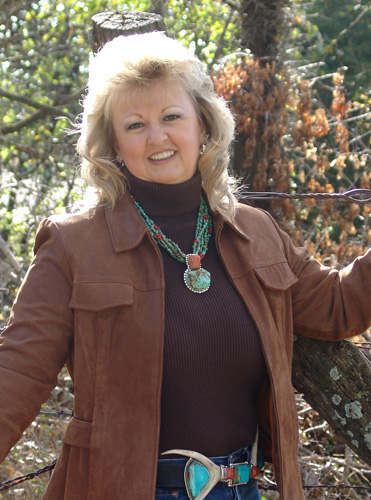
Many artists have now started using a variety of other stone alone or to compliment their turquoise pieces. The belt pictured above is an good example. This sugalite stone concho is a beautiful work or art.
Hope you enjoyed a little history on the Native American Jewelry.
Gayla

Wednesday, March 25, 2009

Native American Turquoise Jewelry


The beautiful blue and green hues of turquoise have long been prized by the Native American people of the southwestern part of the USA. Entire cultures were built on mining turquoise and crafting sacred and special items from the attractive stone in areas which are now part of both New Mexico and Nevada. American Indian people were making necklace strands and other turquoise jewelry by hand many centuries before the first European settlers arrived. Because turquoise was so highly prized, it was widely exchanged and circulated among the Native people of the Americans, and then each of the tribes developed their own unique names for the striking blue stone. Scientific testing has proven that some ancient beads found in central and South American were originally dug from the Cerrillos turquoise mines near Santa Fe, New Mexico.

When the Europeans brought the technology of working metals like silver with them to the new world, the American Indians who learned the silver smith trade eventually began to add turquoise with the silver to develop their own special type of jewelry. A Zuni man by the name of Kineshde is believed to be the first to add turquoise to the hand crafted silver items he was making in the late 1800s.
Turquoise first came into popular high fashion in the US during the early 1890s, but Persian turquoise was the focus of the demand at that time, and only a few deposits of high quality turquoise were known in the US. In the following years, a number of high quality deposits previously worked by Native Americans were " rediscovered", and shortly after 1900 Americans began to recognize that American turquoise from the Western US was the equal of any in the world. Interest again began to peak around 1908-1910, and a considerable amount of American turquoise was mined, especially in Nevada. The majority of the Turquoise jewelry produced prior to 1910 was made by well-known jewelry manufacturing companies like Tiffany's, and was produced in the standard Victorian styles of those time.
None of this was what we would recognize as Indian style turquoise jewelry. There were a few Native American making turquoise and silver pieces in what we now see as the traditional style, but they produced very few pieces and their simple tools increased the man hours each piece needed for completion. That era was essentially the dawn of the traditional styles for silver-turquoise jewelry. America's fascination with turquoise and genuine Indian Jewelry really began in earnest during the 1920's when more people from outside the southwest began to see the beauty of this artistic jewelery. At that time, the Harvey House restaurant chain opened a number of facilities across the southwest during the great days of popular rail travel across the US. At first, Indian Jewelry was only sold as curios in the restaurants for the patrons touring the west. Earrings and thin, small bracelets stamped with arrows and bows and containing symmetrically cut small oval pieces of turquoise were the types most in demand. The pieces produced during this time are still termed as having been made in the "Fred Harvey" styles. Heavy Indian Jewelry did not become popular until after 1925, when the classic squash-blossom craze lasted until about 1940, when they were discontinued for the most part by most Indian artisans for requiring too much work and too much turquoise.
As you can see this beautiful stone has been around a very long time, and admired as much now as in the past. It is a staple in everyone's jewelry box.

Friday, February 13, 2009

How to spot fake Turquoise Jewelry


For at least 8000 years people have coveted turquoise. In the early times, different cultures believed turquoise brought luck. Due to the high demand, turquoise was heavily mined leading to the decrease of high quality gemstones. Different enhancements used on low quality stones make them difficult to tell from the real thing. Follow these steps to spot fake turquoise.
1) Ask where the jewelry comes from. Today, turquoise is mined in Iran, China, Tibet and the southwestern United States. Fake turquoise can come from anywhere.
2) Look at the vibrant colors of real turquoise, which ranges from a light sky blue to a gray-green color. You want to see a uniform color throughout the stone. Fake or low-quality turquoise is a pale, chalky stone injected with dye. Turquoise comes from a process of millions of years where water leaks over rocks with high mineral content of copper, iron and aluminum.
3) Study the quality of the color. The bad or fake stuff often appears clear, as if you could see through it. The good stuff carries a more solid, opaque quality to it. However, even good quality turquoise can fade over time when exposed to sunlight, heat or chemicals.
4) Check the turquoise for the existence of veins or blotches, which are called the matrix. Although not all real turquoise has it ,many stones do have a matrix that varies from white to black in color ( see the above photo for a heavily matrix-ed piece).
5) Notice any smell to the gemstone. Reconstituted turquoise carries a certain odor that comes from the resin used to bond turquoise dust and pieces together. Dyes and minerals try to duplicate the color and matrix of real turquoise.
6) Price the piece of jewelry and expect it to be high. With turquoise supplies dwindling, the prices of good turquoise are rising. Consider high quality turquoise as an investment that will appreciate like diamonds or emerald.
7) Buy real turquoise jewelry from a reputable dealer and ask for a certificated of authenticity. Most of the good pieces are signed by the artist.
Hope this helps you with your turquoise shopping.

Monday, December 1, 2008

Turquoise Jewelry


Hope this finds you all well and ready for the Holiday Season!!!
The next few posts I want to discuss a little bit about turquoise jewelry. This time I am going to post a few turquoise facts.
1-- Turquoise is the birthstone for the month of December ( my mother as well as two of my granddaughters are lucky enough to have this as their birthstone). It is also associated with both the fifth and the eleventh wedding anniversaries.
2-- With the dwindling global reserves of turquoise and the supply much less than the growing market demand for turquoise jewelry, prices of turquoise jewelry are expected to escalate in the coming years. Due to this economic dynamic, purchases of high-quality turquoise jewelry pieces can be viewed as an investment in an appreciating asset-much like diamonds or other valuable gems and stones.
3--In the 17th century England, gentlemen would not step out in public without wearing turquoise jewelry. The wearing of turquoise jewelry was considered to be a sign of a well dress gentleman.
4--Considering the millions of years it takes for turquoise to form, you will want to handle your investment with care. Turquoise is a naturally porous gemstone and as a result it can change color if not cared for properly. Cosmetics, perfume, high heat, oils and a lot of direct sunlight can affect the color. It's best to clean your jewelry piece then store it in an airtight bag. Since MOST turquoise is set in sterling silver this will keep the stone protected and the sterling from tarnishing. Who wants to get ready to put your piece on and have to clean it first.
5--In 1810 Napoleon Bonaparte presented his Empress Marie Louise with a wedding gift --a breathtaking crown of diamonds and turquoise. Originally the crown was made up of diamonds and emeralds, but Napoleon arranged to have all 79 emeralds removed and replaced with turquoise prior to giving the crown to Marie Louise.
6--This gemstone has been mined for thousands of years by various cultures, with evidence suggesting that the ancient Egyptians mined turquoise as far back as 6000 B.C. In modern day, turquoise is mined in a number of places including the US, Iran, China and Tibet.
7--Turquoise is formed , over a span of millions of years, by a chemical reaction that occurs when water leaks through rocks which specific minerals such as copper and aluminum. The percentages of those various minerals in the rock dictate the gemstone's shade.
These are just a few facts about this fantastic stone.
Thanks for dropping in on us.
Gayla